What Is an AI Automation Agency (and Do You Need One)?

What an AI agency is, before we narrow it down
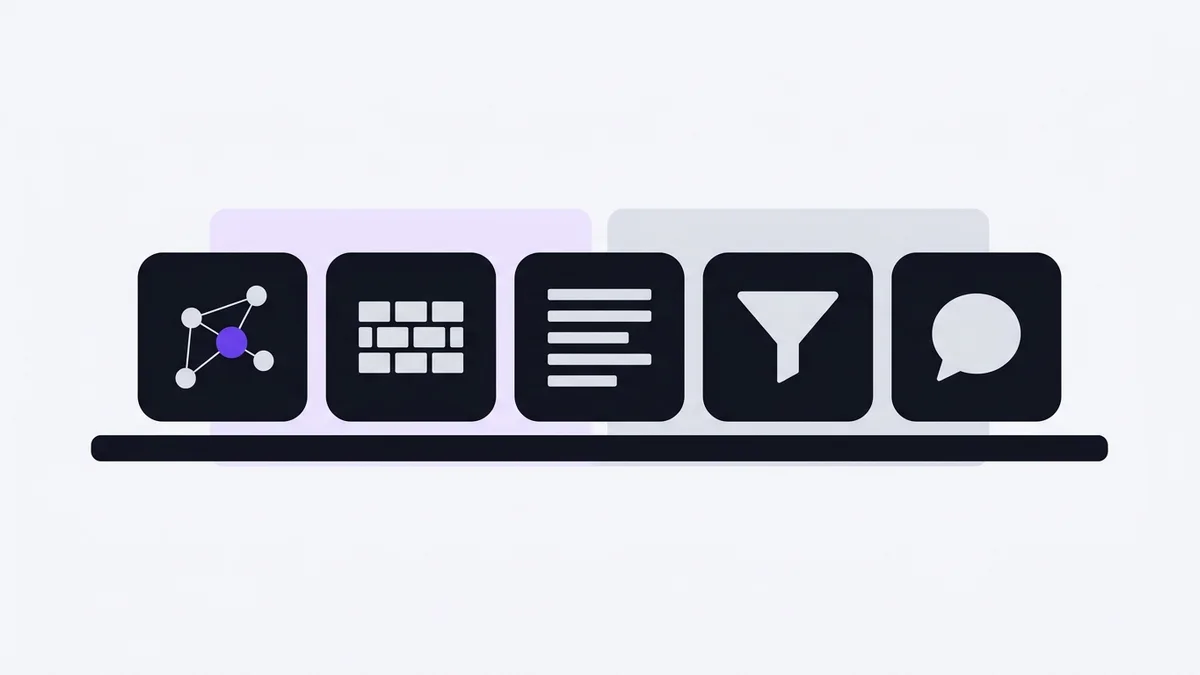
“AI agency” is a container word. It currently covers at least five businesses that share almost no skills, and picking the wrong one is the most common expensive mistake in this market.
AI automation agencies connect the tools you already run so that work moves between them without a person copying and pasting. Orchestration in n8n, Make or Zapier, with custom code and model calls where an off-the-shelf connector will not do the job.
AI agent development companies build software: a product surface, a retrieval layer, evaluation harnesses, an application that did not exist before. This is engineering with a release cycle, not workflow configuration.
AI consultancies sell judgment before code. Strategy, opportunity assessment, governance, model selection, occasionally a proof of concept they hand to somebody else to build.
AI marketing and sales agencies run a marketing or outbound function using AI tooling. The deliverable is pipeline or creative, not a system.
AI SEO and GEO agencies work on whether you get named when a buyer asks an assistant for a recommendation.
All five answer the phone when you say “we need help with AI,” and we rank all five separately for exactly that reason. If your problem is that invoice data gets retyped into three systems, an AI consultancy will sell you a readiness assessment for it, and both parties will be disappointed.
This piece is about the first one. If you are here to start an agency rather than hire one, this is not the guide for you; everything below is written from the buyer’s chair.
What an AI automation agency actually builds
Strip the language away and the work is integration plus judgment.
The integration half is ordinary and unglamorous: move a record from the form to the CRM, from the CRM to the accounting system, from the accounting system to the warehouse, and tell somebody in Slack when it fails. This has existed for two decades under the name systems integration. Zapier made it clickable, n8n and Make made it programmable, and none of it requires a model.
The AI half is the part where a step needs a decision that a rule cannot express. Reading an unstructured supplier invoice and returning the line items. Classifying an inbound email into one of eleven routing categories. Summarizing a call transcript into CRM fields. Deciding whether a document is complete enough to file. These are the steps that used to require a human read, and they are the reason the category exists at all.
A good agency is candid about the ratio. On most engagements the model does one or two steps out of fifteen, and the value is in the fourteen boring ones. A firm that pitches “AI agents” for a workflow that is really six API calls and a conditional is selling you the expensive framing of a cheap problem.
The unglamorous deliverables are also the ones that separate competent work from a demo: error handling, retries with backoff, idempotency so a re-run does not duplicate records, credential management, logging you can search, alerting when a workflow fails silently, and a documented handover. Ask about those in the first call. The answer is a reliable proxy for everything else.
How to tell the specialists from the generalists
The label hides a genuine range. Our own data on the 36 reviewed agencies working in automation and no-code categories shows the spread plainly: one-person operations such as AiAdvisors, where the entire delivery capacity is a single named individual, sit in the same category as SVA System Vertrieb Alexander GmbH, a 3,800-person German system integrator where n8n is a small specialist practice, and AOE Group, where automation is one line inside a 200-plus person digital agency.
Neither end is wrong, and both are wrong for somebody. The single operator gives you the deepest platform knowledge and the fastest decisions, with no backup if he is unavailable. The system integrator gives you institutional continuity, procurement paperwork and a security review, and makes you a minor account. The useful question is not which is better but which failure mode you can survive.
A second sorting signal is service surface. When an agency lists nine industries, nine service lines and eleven tools, as 2V Automation does, it is a general automation consultancy that works in n8n rather than an n8n specialist. That is a fine thing to hire, as long as you are not paying a specialist premium for it.
What it costs, in real numbers
We collect published prices rather than estimates, and the first finding is about availability. Of 116 reviewed agencies, 74 publish a minimum budget anywhere we can cite, on their own site or on a directory. The other 42 publish nothing. Across those that do publish, the median entry point is $10,000.
Inside the automation categories specifically, the published floors run from $750 to $50,000. MinorCo publishes the lowest genuine entry point at $750 for done-with-you training, with done-for-you projects at $5,000 to $30,000. Axe Automation, Makeitfuture, Connex Digital and Width.ai all sit at a $1,000 floor. 2V Automation and Bitovi start at $5,000. Azati, BotsCrew, LeewayHertz and TrueHorizon AI start at $10,000. Master of Code Global starts at $25,000, and Markovate at $50,000.
Hourly rates published on Clutch spread just as widely: $25 to $49 for Azati, $50 to $99 for 2V Automation and BotsCrew, $150 to $199 for Bitovi, $200 to $300 for Connex Digital, and $250 flat for XRAY Tech, which also publishes a $15,000 monthly retainer on its own site.
Two things follow. A quoted number is only interpretable next to what it buys, so treat a $1,000 floor as the price of a single workflow rather than the price of a program. And a firm that will not put any number in public before a discovery call has made a choice about transparency that you are allowed to weigh. Our AI automation agency ranking shows the published figure, or its absence, on every listing, and the pricing guide breaks down what actually drives the number.
When hiring one is the right call
Four situations, drawn from the pattern across the agencies we track:
- A documented, repetitive process with nobody free to build it. The requirements already exist, and you are buying execution capacity rather than discovery.
- An integration with no native connector. The work is custom code against an API, which is where a specialist beats an internal generalist by a wide margin.
- Something already automated that fails silently. You need error handling, monitoring and observability retrofitted, which is a specific and unglamorous skill.
- A deadline that a hiring process cannot meet. An agency starts in two weeks; a hire starts in three months and needs onboarding.
There is a fifth argument in circulation and it deserves a careful reading. MIT’s Project NANDA published “The GenAI Divide: State of AI in Business 2025”, reporting that the large majority of enterprise generative AI pilots produced no measurable profit-and-loss impact, and that buying from specialized vendors succeeded roughly twice as often as building internally. Treat it as directional. It is an industry report rather than peer-reviewed research, the sample sizes are described inconsistently across versions, and the headline figure has been widely contested. It is still the most-cited piece of evidence that external delivery outperforms internal builds in this category, and it is fair to weigh it as long as you do not quote it as settled fact.
When you should not hire one
The cases where an agency is the wrong purchase are more common than the category admits.
The process is not documented. If nobody can write down what happens today, including the exceptions, an agency will bill you to discover it and will get it partly wrong. Map it yourself first. This is free and it is the highest-return hour in the whole project.
The process should be deleted, not automated. A recurring report nobody reads, an approval step that has never once resulted in a rejection, a reconciliation that exists because two systems disagree. Automating these makes bad process permanent and adds a maintenance burden. The correct deliverable is sometimes a decision, not a workflow.
It is one workflow and you have a technical person. A single Zapier or Make automation across tools with native connectors is an afternoon for a capable operations hire. Paying an agency $5,000 for it buys you documentation and a dependency.
The volume does not justify it. If the task runs twice a month and takes twenty minutes, the annual saving is roughly eight hours. No build pays that back.
Your data is the problem. If the CRM is full of duplicates and the product catalog disagrees with the invoicing system, automation propagates the mess faster. Fix the data first, and be suspicious of anyone who quotes the build without raising it.
You want to own it long term and have nobody to own it. Handing an undocumented workflow estate to a team with no capacity to maintain it produces a system that quietly stops working and nobody notices for a quarter. If you cannot name the internal owner, buy managed operations explicitly or do not buy at all.
The in-house alternative, stated fairly
For a company with steady automation needs, one operations engineer who lives in n8n or Make will out-deliver an agency retainer over a year, because most of the cost of automation is context about your business rather than platform skill.
The honest comparison is this. An agency wins on time to first result, on depth in a specific platform, and on work with a defined end. In-house wins on everything that is ongoing, because the second workflow is much cheaper than the first once someone already knows your data model.
A defensible pattern many buyers land on: hire an agency for the first hard build, require documentation and a handover as a contractual deliverable rather than a courtesy, and keep a smaller retainer for the parts that genuinely need a specialist. If an agency resists that shape, it is telling you its business model depends on you not developing the capability.
Our AI automation agency ranking covers the firms we have reviewed, with an honest drawback on every listing, and the n8n agency ranking narrows it to the platform specialists.